The buffer dilemma: how AI embraces inherent unpredictability to uncover hidden stand capacity
At many European airports, 40-50% of pre-planned stand allocations require changes during day-of-operations. This is not a failure of planning; it is the natural state of a highly interconnected sector where multiple stakeholders in a dynamic environment need to constantly adapt to operational delays in the pursuit of the positive passenger experience. The result is inherent, irreducible uncertainty.
At many European airports, 40-50% of pre-planned stand allocations require changes during day-of-operations. This is not a failure of planning; it is the natural state of a highly interconnected sector where multiple stakeholders in a dynamic environment need to constantly adapt to operational delays in the pursuit of the positive passenger experience. The result is inherent, irreducible uncertainty.
The military adage, "No plan survives first contact with the enemy," finds its aviation equivalent at roughly 6:00am, when the gap between scheduled times and operational reality becomes apparent. Consider the daily transatlantic morning bank of flights at European hubs: flights from North America routinely land 30-60 minutes ahead of schedule. Instantly, the carefully optimized stand plan built the day before faces its first major disruption, triggering a cascade of reactive adjustments.
To thrive in this environment, airports must transition from planning against uncertainty to planning for it. This shift requires moving away from scheduled times and rigid, static constraints to leveraging AI-driven predictive insights to manage the airport’s largest operational lever: the aircraft stand.
The business impact
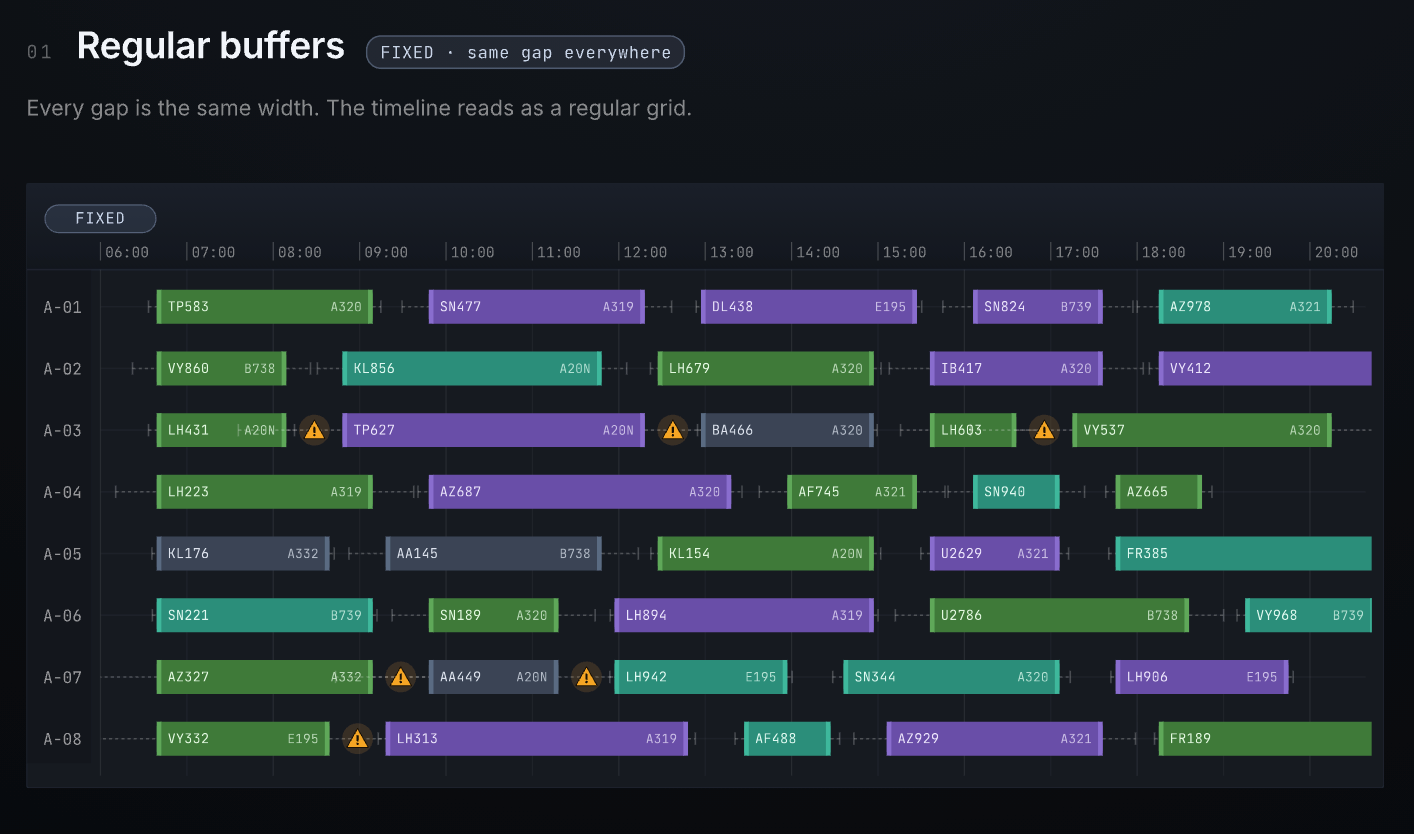
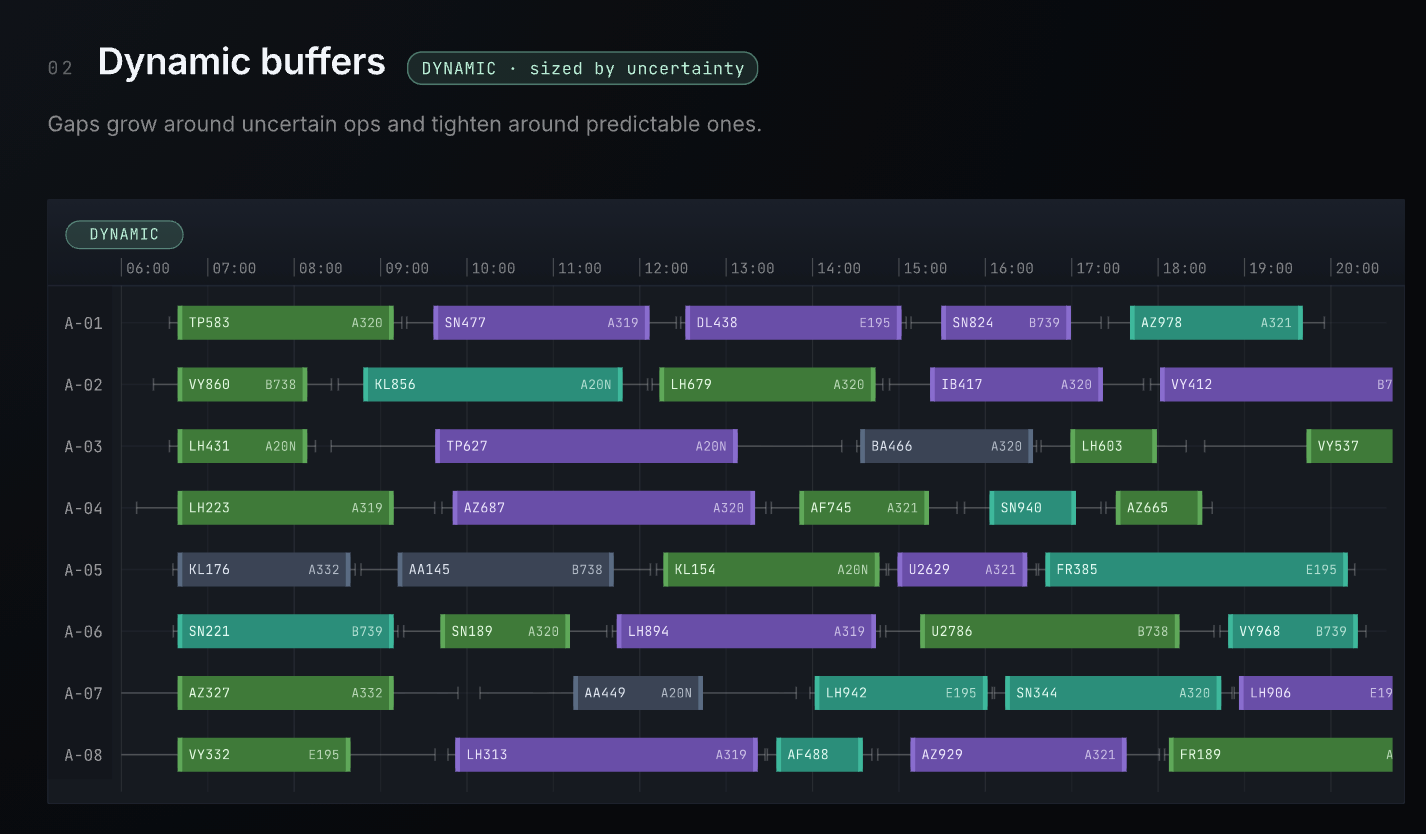
Most airports today protect their schedules with static buffers — a blanket 15–20 minutes wedged between every turnaround. It feels safe, but it quietly caps capacity. AI-driven dynamic buffers do something smarter: they widen the margin where flights are uncertain and tighten it where arrivals are highly predictable.
When tested against static buffers at the same resilience level — apples to apples — for a large US-based airline at its primary hub, the results speak for themselves:
- +5% peak stand capacity by narrowing buffers on predictable rotations
- Up to 19 extra flights per day, safely compressed without added schedule risk
- The equivalent of 4 new physical stands — no construction, no disruption, no capital project
That's unprecedented infrastructure utilization from assets you already own.
Capacity is a variable, not a constant
Traditional airport planning often treats gate and stand capacity as a fixed asset count i.e., a static number of aircraft parking positions available to be filled. However, operational reality consistently demonstrates that usable stand and gate capacity is not constant. It is a fluid, minute-by-minute variable, constantly shaped by:
- Arrival variability: Early or late arrivals that disrupt pre-planned sequencing.
- Aircraft rotations: Delayed turnarounds, effectively trapping the next scheduled aircraft.
- Turnaround robustness: The predictability of ground handlers, catering, and fueling teams meeting scheduled timestamps.
- Gate compatibility constraints: Rigid physical and regulatory requirements, from Schengen/non-Schengen segregation to wide-body clearances.
- Recovery decisions: The tactical choices made by operations teams trying to mitigate minor delays in real time.
When these forces collide, a static plan cracks. Research and performance reporting from ACI Europe consistently demonstrates that dynamic allocation efficiency (i.e. how fluidly an airport reallocates resources on the fly), is a far stronger determinant of optimum performance than the physical asset count itself. This paradigm shift was central to the ACI Europe Performance Position Paper 2025*, which prompted airports to step into a more active orchestrational role:
“Airports are both participants and leaders in performance management, orchestrating collaborative efforts while ensuring safety and sustainability. By focusing on inputs, leveraging data-driven tools, and engaging stakeholders, airports can deliver reliable, on-time, and sustainable operations that support aviation’s growth and resilience.”
Peak demand is not linear
The failure of static planning becomes most acute during peak periods because physical infrastructure is fundamentally non-linear. Peak periods are driven by operational waves, not neat calculated averages. Infrastructure sized for average demand inevitably sits underutilized for most of the day, yet it routinely saturates quickly and fails when a heavy wave of aircraft arrivals hit the apron. It often only takes a few deviations from the schedule to break the entire system.
According to network flow studies by EUROCONTROL, operational inefficiency is primarily caused by misaligned scheduling, not an absolute shortage of physical stands. This systemic inefficiency does not stay contained at the gate; it ripples across the entire network, impacting on-time performance, financial resilience, and passenger experience.
To insulate against the chaotic, unpredictable airport environments and the downstream delays they cause, airports and airlines have been forced to defensively alter their stand- and flight planning behaviour. As documented in EUROCONTROL’s European Airline Delay Cost Reference Values** airlines routinely mask ground operational variability by artificially inflating their flight timetables with buffers. At the same time airports add extra minutes of buffer between two turnarounds on the same stand during peak periods.
According to EUROCONTROL, 30-60 minutes of buffer time is routinely added to an aircraft’s scheduled block time to absorb the unpredictability of the apron. EUROCONTROL presents this rigid buffer as a severe systemic waste, proving that keeping an aircraft and crew intentionally idle incurs staggering fixed capital penalties.
The Hidden Cost of Playing It Safe
To absorb apron unpredictability, airlines and airports both pad their plans. EUROCONTROL reports that 30–60 minutes of buffer is routinely added to scheduled block time - keeping aircraft and crew deliberately idle.
That idle time isn't free:
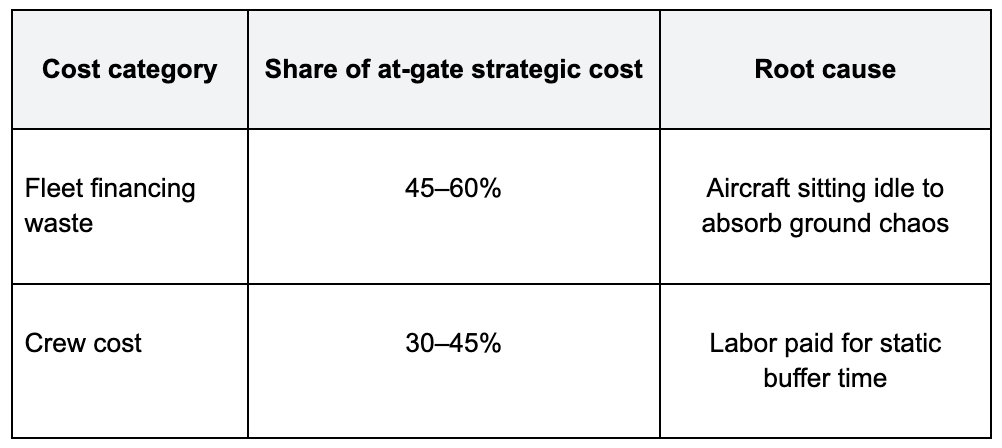
The logic is straightforward. If airports can make ground operations and turnarounds more predictable at the stand, airlines can safely strip away these expensive buffers. Everyone wins.
Stand planning as the ultimate catalyst for airport operational efficiency
Within the complex, multi-stakeholder ecosystem of airport operations, stand allocation alongside real-time complete turnaround visibility represents the most impactful variable under the airport’s direct control.
While flight schedules require alignment with airline commercial teams and air traffic flow is governed by national bodies, stand planning sits squarely within the airport’s domain. It is an active operational lever. Every decision made at the stand cascades dynamically through the entire network, acting as a primary driver of three critical areas:
- Passenger flow and Commercial optimization: Where an aircraft parks dictates the entire downstream passenger journey. The stand allocation determines walk times, flight connections, busing requirements ,and border control queues. Crucially, it governs exactly when and where passengers enter departure lounges - directly influencing dwell times, footfall patterns, and non-aviation retail revenue.
- Synchronized resource allocation: Stand allocations act as the baseline schedule for the entire ground operation. They drive the deployment schedules of ground handling equipment (GSE), dictate catering and fueling truck routing, and establish the staffing requirements for all kinds of groundhandling activities.
- Airside operational efficiency: The stand plan directly influences taxi durations, runway queue configurations, and turnaround predictability. A well-orchestrated stand allocation minimizes congestion on the apron, directly protecting the airport’s overall On-Time Performance (OTP).
By recognizing stand planning as a proactive steering wheel rather than a reactive puzzle, airports can actively shape their operational performance rather than simply absorbing the shocks of delays and conflicts.
The predictability paradox
The central challenge of managing this operational steering wheel lies in a profound paradox: while individual flights routinely deviate from their scheduled times, their deviations are often highly predictable.
Walk into any airport control center, and you will find stand planners with decades of experience who possess an extraordinary, intuitive understanding of the operation. They know precisely which afternoon flight from a specific regional hub always arrives twenty minutes early, which connecting banks require tight physical proximity to protect baggage transfer windows, and which departing passenger demographics will drive the highest retail traffic.
The systemic bottleneck is not a lack of intelligence; it is a problem of data centralization. This priceless institutional expertise typically exists exclusively in planners' heads rather than in the core systems they use daily. Legacy stand-management software treats the schedule as gospel, completely unable to digest probabilistic or anecdotal insights. Without analytical validation, this veteran knowledge remains tribal and unquantifiable.
Modern AI-driven solutions bridge this operational gap. By ingesting and analyzing real-time operational data, as well as implementing user-based rules, these solutions can provide an estimated scheduling buffer between flights that use actual operational data specific to each flight and its circumstances.
Planning for uncertainty, not against it
The traditional instinct in aviation is to constantly wage war against variability - pursuing absolute schedule punctuality as the ultimate metric. While admirable, this rigid approach misses a fundamental reality of modern aviation: in a hyper-connected sector with dozens of independent stakeholders and severe infrastructure constraints, some level of uncertainty is inherent, irreducible, and inevitable.
The strategic question for modern hubs is not how to eliminate uncertainty, but how to plan effectively within it. This requires a fundamental paradigm shift in operational philosophy:
- The Legacy Approach: Creating a pristine, perfectly optimized plan based strictly on static scheduled times, and then scrambling into a chaotic, reactive fallback mode the moment reality diverges at 6:00 AM.
- The Predictive Approach: Constructing a resilient plan built on realistic, probabilistic predictions across multiple time horizons - explicitly acknowledging, pricing in, and accommodating expected variability before it occurs.
This evolution is not about lowering standards or accepting poor performance. On the contrary, it is about building true operational resilience. By planning for the airport operation as it actually runs, operators can shift from a state of constant firefighting to one of continuous, calm orchestration.
Dynamic, intelligent buffers
To resolve the friction between schedule resilience and capacity maximization, airports must rethink how they add buffers between flights.
Resilience vs capacity: the traditional tension
If you look at the resilience of an airport schedule - its constant changes and fluctuations - and physical capacity at the airport, these two factors are naturally at odds forcing planning teams to find a careful balance between the below options:
- The Maximum Resilience Extreme: A schedule where you have a dedicated stand for every flight (e.g., 500 flights a day requiring 500 stands).This is financially and physically impossible for any airport worldwide, and it is entirely unnecessary.
- The Maximum Capacity Extreme: A schedule with a 0-minute buffer between flights. This yields maximum throughput in theory, but even a minor two minute delay triggers a total schedule collapse.
In practice, airports tend to opt for a static buffer between flights - usually a blanket 15-20 minute buffer applied across the entire schedule. This is intended to absorb potential fluctuations throughout the day. However, these static buffers do not look at how certain we actually are of a particular flight’s arrival time. Consequently, in some places airports do not take enough margin to be resilient, whereas in other places they take too much margin, needlessly sacrificing stand and gate capacity.
Stopping the see-saw act with AI
Dynamic buffers solve this exact problem: putting buffers where it is needed to be and reducing it where it isn’t needed. Instead of treating resilience as an accidental consequence of a fixed, static buffer scheduling system, an AI-driven approach allows planners to choose a target resilience level they want to achieve, and the system dynamically configures the timeline to achieve it.

To compare static and dynamic buffers accurately, we must compare apples to apples - meaning both methods are configured to achieve the same exact resilience level in the schedule. When compared under equal parameters in the context of a large US-based airline at their primary hub, AI-driven dynamic buffers optimize the schedule to unlock massive stand capacity gains from existing infrastructure:
- Adds 5% stand capacity during peak periods by narrowing buffers on highly predictable flight rotations
- Provides space for up to 19 extra flights per day, safely compressing intervals without increasing schedule risk
- Delivers the operational equivalent of building 4 extra physical stands at the airport, purely through the implementation of intelligent buffers
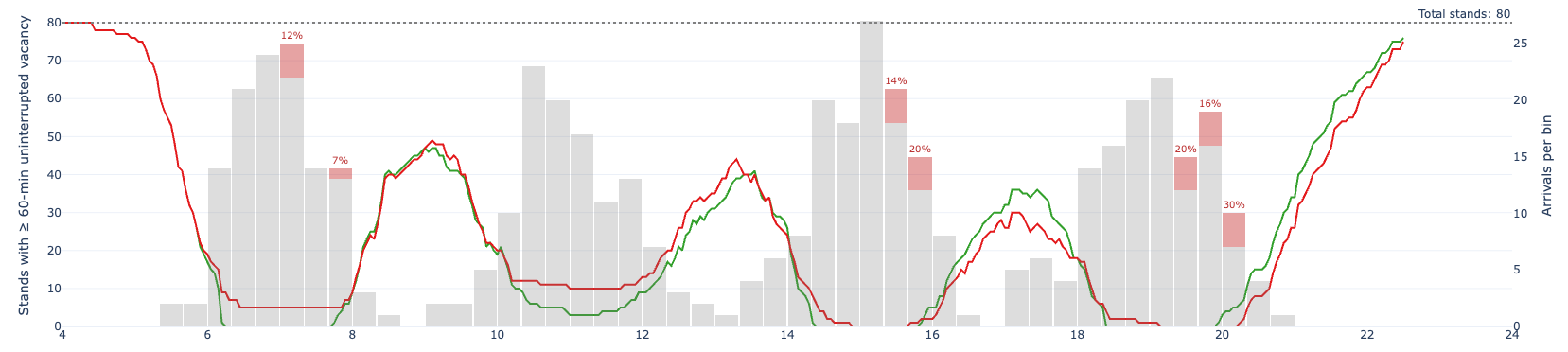
The future of airport efficiency lies at the gate. When airports replace rigid, static assumptions of time with predictive, AI-driven dynamic buffers, they protect operational resilience while simultaneously unlocking hidden capacity.
By optimizing the stand - the airport’s largest operational steering wheel - operators can eliminate the chaos that forces costly airline schedule padding, creating a more streamlined, predictable, and highly profitable aviation network.
Footnotes
*ACI Europe, Performance Position Paper 2025 (Brussels: ACI Europe, November 2025), https://www.aci-europe.org/downloads/resources/ACI%20EUROPE%20Performance%20Position%20Paper%202025.pdf
**Dr. Andrew Cook and Graham Tanner, European Airline Delay Cost Reference Values (London: University of Westminster / EUROCONTROL, December 24, 2015), https://www.eurocontrol.int/sites/default/files/publication/files/european-airline-delay-cost-reference-values-final-report-4-1.pdf


Learn more about ResourceManager