The turnaround has eyes. Now it has ears.
Stand at any aircraft turnaround and you’ll notice two things happening at once. You will see the motion - bags moving, doors opening, steps arriving. And you can hear it too. Someone confirms the walkaround is complete. Someone flags a problem over the radio before it becomes a delay. This second stream of operational information is spoken, immediate, and usually accurate. It is frequently never captured.
Stand at any aircraft turnaround and you’ll notice two things happening at once. You will see the motion - bags moving, doors opening, steps arriving. And you can hear it too. Someone confirms the walkaround is complete. Someone calls out that catering has been waiting ten minutes for ground equipment to arrive. Someone flags a problem over the radio before it becomes a delay.
This second stream of operational information is spoken, immediate, and usually accurate. It is frequently never captured. It is said once, to one person, and then it’s gone. No record, no visibility beyond two people, and no way for anyone managing the wider turnaround operation to utilize it.
At Assaia, we think that is the next visibility gap worth closing.
Where it started: giving the turnaround eyes
For several years, Assaia has focused on a simple problem: operational teams couldn’t see the turnaround as it actually happened. They could see the schedule. They could see the outcome. But they couldn’t observe in real time the sequence of milestones that determines whether a turnaround runs on time or slips.
Assaia’s computer vision technology closes that gap. Cameras around the stand observe the apron and log each turnaround milestone as it happens without relying on someone to notice it, remember it, and manually enter the data afterwards. This gave operators real-time visibility of what was physically taking place during the turnaround, as well as the ability to proactively manage the turnaround while it was in progress.
But, a camera can only tell you what it can see. It has no way to capture the coordination the ground crews vocalize to each other constantly throughout the turnaround.
Another dimension of the turnaround
Now, we are adding a second source of operational data to the turnaround. Assaia is partnering with Frontier Audio, a voice intelligence platform built for critical frontline operations, to connect what is seen on the apron with what is said on the apron, so both feed the same operational picture in real time.
Voice intelligence alone is not new, and used in isolation it doesn’t change much. However, when physical events from computer vision and human speech merge into a single, unified operational picture a true shift occurs. With computer vision providing the eyes and voice providing another critical layer of context, operational teams achieve real-time visibility to proactively manage the turnaround while it’s still in progress.
Frontier Audio recognizes operational meaning in frontline speech under real conditions: engine noise, radio interference, and the general acoustic chaos of a live stand. It filters that out and identifies the parts of vocal communication that carry operational importance. In practice, that means two things for the turnaround.
Speaking an event into the system
The first is that ground handlers can update turnaround events hands-free and in real time, using the language and devices they already use.
There is no screen to find, no keypad to operate with gloved hands, and no new device to carry, and no trigger command or phrasing to memorize. Crews speak the way they already speak to one another, and the system recognizes the operational event within that speech and timestamps it.
That distinction matters more than it might seem. Systems that require specific phrasing get abandoned under time pressure, because remembering the right words is one more task during the busiest few minutes of the turn. Anyone who has watched a well-designed reporting tool go unused on a ramp has usually watched exactly this happen. Recognizing ordinary operational speech, rather than requiring a trained one, removes the failure point instead of asking people to adapt to it.
Those spoken updates then sit alongside what computer vision independently observed at the same moment. The two verify each other. The result is a turnaround record built from what was seen and what the people doing the work vocalized — a stronger record than either source produces alone.
Getting the alert to the person who actually needs it
The second capability runs in both directions, and it may impact daily operations the most. Today, when a solution like Assaia’s ApronAI raises an alert, it arrives on a screen.
Someone has to notice it, interpret what it means for a particular aircraft, then pick up a radio or a phone and relay it to the crew on stand. Every one of those steps costs time precisely when the turnaround has the least of it to spare.
Delivering the alert as audio, directly to the person on stand, removes that relay entirely. The individual hears what they need to know at the moment it becomes relevant - without stopping what they’re doing, without finding a device, and without taking their eyes off the aircraft or their hands off the equipment. During a live turnaround with ground support equipment in motion, hands-free is not only faster. It is safer.
It also gives ground handling crews something they’ve rarely had: visibility beyond a single aircraft. A ramp crew or turnaround coordinator can now understand how their turn connects to what is happening around them. That operational context has historically lived in the control center, if it existed at all. Giving it to the people on stand changes what they are able to do with it.
Nothing new to do
This is worth stating plainly, because it is usually the first question an operations team asks. The capability requires the same type of equipment crews currently use (headsets) and encourages the same processes that “should be” occurring per the ground operations manuals. Ramp teams are already wearing headsets to support the pushback and hearing protection is required for safety. By wearing the headsets earlier in the turn process, the event timestamps are captured through AI and there’s a process for more clear communication in what can be a noisy and chaotic environment. Crews speak normally as they do and the system is passively marking down key milestones or alerting on deviations only when appropriate.
On the dashboard, only operationally relevant information appears, alongside Assaia's computer vision events. This provides teams a clean, actionable view built around the turnaround, designed to help optimize it while it’s still live rather than review it afterwards.
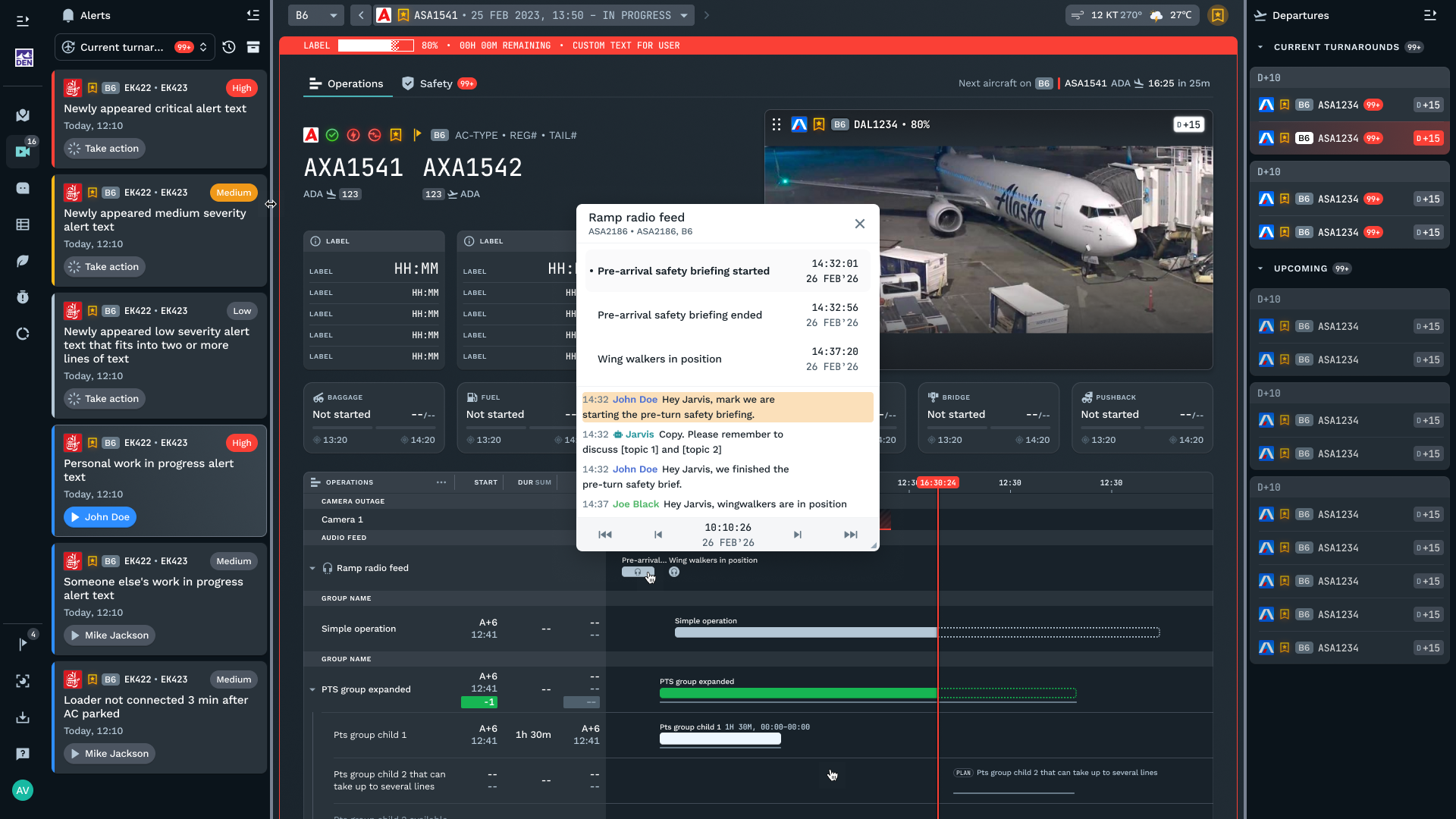
The capability is designed for both airlines and ground handlers, which reflects an obvious reality: both parties rely on the same information because turnaround performance depends on the two working from it together.
What we have learned so far
We have trialed this combined capability with a major US airline and its ground handling partners across live turnaround operations, and those deployments have shaped this phase of development.
Participating teams told us that having ramp context available alongside turnaround events made coordination across the turn faster and more straightforward. Just as usefully, we learned which events benefit most from voice, where hands-free delivery makes the greatest difference, and how frontline teams actually adopt a capability like this in a live operation rather than in a demo. An added benefit is the clarity in communication that Frontier’s hardware provides with both noise cancelling and hear through capabilities.
See it live at FTE Global 2026
We are demonstrating the combined capability at FTE Global 2026 on Thursday 10 September, 11:30–12:30, including the practical lessons from live deployment.
If you would like to see it, or to arrange a meeting, get in touch at info@assaia.com or via the website form.


Optimize your turnaround